
How our role as regulator can support and develop the future of the osteopathy profession
15 April 2026
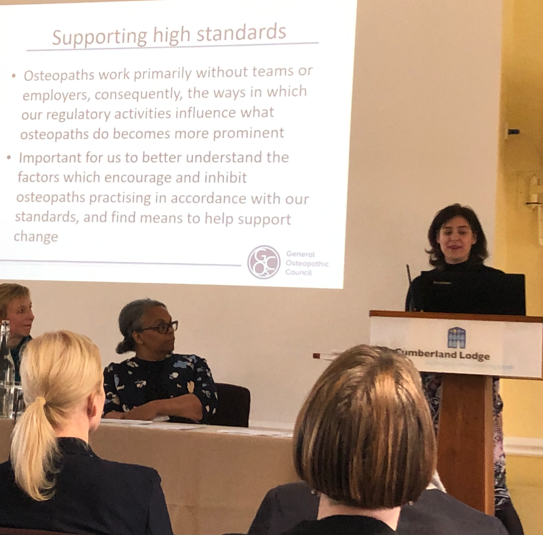
Fiona Browne, Director of Education, Standards and Development, explains how the GOsC is working collaboratively to support the future of osteopathy in the UK.
The College of Osteopaths, which has been operating for more than 70 years, closed earlier this year, and the rest of the course is now being delivered by the University of Derby. My colleagues and I have worked closely with educators at the college for many years now and share the sadness for this closure, whilst at the same time continuing to support students and colleagues in Derby to deliver this course to meet the same high standards.
It would be understandable for there to be a sense of worry among osteopaths and students about what this means for the future of osteopathy. While the closure of a long-standing education provider is not something to be taken lightly, there are many reasons to be hopeful for the future of osteopathy.
Some may think our role as regulator is only to protect the public by holding osteopaths accountable to high standards and investigating complaints, but in fact we are also responsible for ‘developing’ the profession. This means supporting osteopaths in giving excellent osteopathic care for patients and also helping patients be confident that their osteopath meets high standards of competence, conduct and ethics.
So we make sure only those who are qualified and practising to the Osteopathic Practice Standards (OPS) enter the register, and that the profession can continue to give excellent care to more patients, to prevent concerns being raised. We do this by, for example checking and assuring the quality of undergraduate education, checking that osteopaths keep up to date with their CPD, and using our data about concerns to identify areas of risk and encourage osteopaths to focus on these areas in their CPD.
Developing the profession also means enabling people to qualify as osteopaths or to demonstrate meeting the OPS in different ways. We’ve been supporting three exciting projects that will hopefully do exactly this.
New osteopathy Masters course in Liverpool
We’ve been in conversation with Liverpool John Moores University about their plans to introduce a four year full time Masters in Osteopathy Programme (MOst). Our Policy and Education Committee agreed to the specification for our initial review of the course, which is likely to happen at the end of 2026. Our initial review will take place long before any students are recruited to the course, and will look at things like programme and curriculum design to make sure the Standards for Education and Training are properly embedded within the course before it begins.
We’re working closely with the staff at LJMU as their plans progress, to make sure everyone has a good understanding of the standards and the Graduate Outcomes that students must meet before they can join the Register after graduation.
Recognition of osteopathic qualifications from New Zealand
Earlier this year the GOsC signed a Memorandum of Understanding with the Osteopathic Council of New Zealand to streamline the international registration processes between the UK and New Zealand. By making this agreement, we hope to remove barriers that either prevent or unnecessarily delay osteopaths qualified in New Zealand from practising in the UK, and vice versa.
Our agreement notes what is required of osteopaths in the UK and New Zealand to be registered, for example alignment in CPD requirements and undergraduate qualifications, and explains how osteopaths in New Zealand could gain registration in the UK (and vice versa). Enabling qualified and competent osteopaths from New Zealand to register and practise in the UK will support the osteopathic profession to continue meeting the needs of patients and will improve public access to safe and competent osteopaths.
Standard for osteopathy apprenticeships
And finally, during 2025, we supported the Institute for Apprenticeships and Technical Education (whose function has now been transferred to Skills England), the Institute of Osteopathy and osteopath employers to develop an osteopath apprenticeship standard that meets our Graduate Outcomes. The goal is to remove the financial barrier to becoming a qualified osteopath that university presents to many people, offering instead a chance to get a university level degree and professional qualification with fees funded by government whilst being paid by an employer.
It's our role to make sure anyone who completes an osteopathy qualification in the future using this new degree level apprenticeship standard will meet the Graduate Outcomes, and will therefore be able to practise safely and according to the Osteopathic Practice Standards. In short, while we don’t design these apprenticeship qualifications, we would assess each one developed by higher educational institutions in conjunction with employers to make sure apprentices can go on to become safe and competent osteopaths.
Our role in supporting osteopathy
While we want to see the profession thrive, with each of these projects we must also make sure that we are maintaining the same high standards of osteopathic practice, prioritising the safety of patients and the public and quality of care, and protecting the reputation of the profession. When we support projects such as these, we are primarily doing so through the lens of public protection – using our robust governance framework and the OPS to deliver fully qualified, competent, ethical, safe osteopaths who can meet the needs of patients in the UK.
It's important to us that osteopaths have confidence not only in the standards of entry to the register but also in our role as regulator. If you have any questions, you’re welcome to come along to one of our online drop in sessions, or invite us to come and speak for free to your local CPD group.
You can contact us on:
- WhatsApp: 020 7046 0406
- Email: info@osteopathy.org.uk
- Phone: 020 7357 6655

